Showing posts with label brassieres. Show all posts

Saturday, October 13, 2012

Over the Shoulder Boulder Holder


 Take a look at this marvel of engineering!  My poor dress form is not up to displaying a brassiere of this magnitude.  This is a size 44 Camp fan-laced brassiere.  Made of sturdy, flat-felled, pink polished cotton, you can see that you can adjust your lift with the underbust slings and buttons.

Hooks and loops on the left side got you into this marvel.  Then. . . .

You pulled on the elastic garters to cinch it up and flipped down the catches, like a girdle garter.

You know I'm going to look up the patent!

Adjustment Buckle Structure
Samuel H Camp, Jackson, Michigan, Assignor to S H Camp & Company, Jackson, Michigan, a corporation of Michigan

Patent number: 2053600
Filing date: May 25, 1934
Issue date: Sep 8, 1936


Here is a link to a wonderful collection of fan-laced corsetry.  Fan-Lacing Corsets  I can't do any better than referring you to their pages to "read all about it".  There is one brassiere shown, though not like mine.  Here are some more fan-laced corsets.

Samuel Higby Camp was born 29 September 1871 in Jackson, Jackson, Michigan, the son of Henry N Camp and Ella M Higby.  He was single when he patented his corset closing system in 1908 and was 46 when he married Mary Margaret Hammond, age 49, on 29 June 1918.  He died in 1944 and his Find-A-Grave entry is here.  
Even though a bachelor, he paid attention to his mother's and sister's clothing needs and invented a corset stay improvement in 1896, an adjustable waistband for skirts in 1903, an abdominal support device in 1916, as well as other orthopedic improvements.  I must admit, however, that I was not able to find the 1908 patent referred to, above, which I found quoted in several places.

This is a page from The Journal of Bone and Joint Surgery by The American and British Orthopaedic Associations, in October of 1944.  (That back looks more like a front to me!)
Samuel and Mary Margaret did some world traveling after they were married and he put out another book about women's anatomy for physicians and surgeons.
The only other thing I could find about this inventor was that his company is still in business putting out support garments for injuries and back problems and there is a Samuel Higby Camp Foundation that makes grants, but I was not able to find a website.

Thursday, August 2, 2012

Meant To Be Seen

I'm sure this sweet brassiere was meant to be seen through one of the filmy georgette blouses of the 1920's.  Just look at that lace!  I just wonder how often those silk ribbon straps snapped, though, as the ones I've seen are usually just hand-stitched on.


 Here is the back.


As you can see, this is new old stock.  Never worn.  No maker, either.


This one is likely from the 1930's.
It's apparent that support is becoming more important.  Look at the reinforcement on the cups.


Here is the inside.
An early attempt at lifting and separating.


The back, with some nice, heavy elastic.


I wish I could read the label, but someone washed this never-worn bra.
If anyone has seen a tag that looks vaguely like this one, please let me know what it says!


Monday, July 30, 2012

Two Early Brassieres

An unmarked, probably 1930's brassiere, never worn.  Ecru lace top and bottom, silk ribbon straps, rayon cups.


The back is rather low, and has hook and eye tape.


If you blow up the picture below, you can see the rough finishing and the long machine stitches.  Gone are the days of hand-made lingerie.


A really pretty bandeau type bra, yet with cups.  This would look nice with a wrap top.  The lace and cups are cotton, the straps are silk ribbon.

It has three back hooks and eyes.


And a tag I can't read.  It says Silver something.  If anyone has one of these that's readable, please let me know.


Sunday, July 29, 2012

Sil-O-Ette

More of a combination garment than a brassiere, the patent dates this to 1935-1937.  The patent is actually for the way the garment is cut so that it hugs the figure--something new for that time, I guess.

The brassiere is lined in cotton, and the rest of the garment is rayon knit.  The straps are silk ribbon.

It closes on the side with hook and eye tape.


It actually looks very comfy, and quite a change from a corset.


The Sil-O-Ette Intl. Apparel Company is still in existence in Clearwater, FL, although their offerings now are run-of-the-mill fleecewear and t-shirts.

Thursday, July 26, 2012

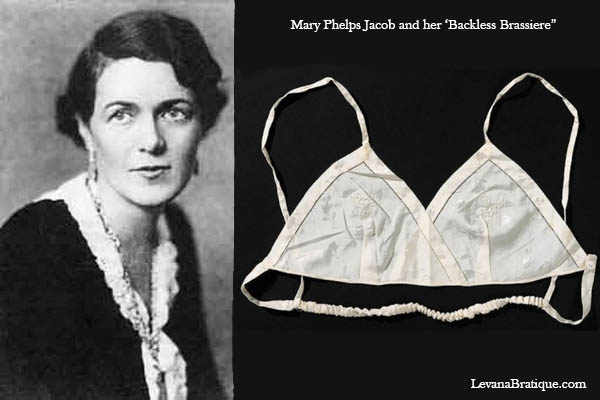
Mary Phelps Jacob, Inventor of the Modern Brassiere


So she is sometimes called.  You can read her story here.  A link to her invention is here.  A Wikipedia article says she was persuaded to sell her fledgling company to Warner Brothers Corset Company by her second husband and join him in debauchery in Europe. (He came to a bad end.)

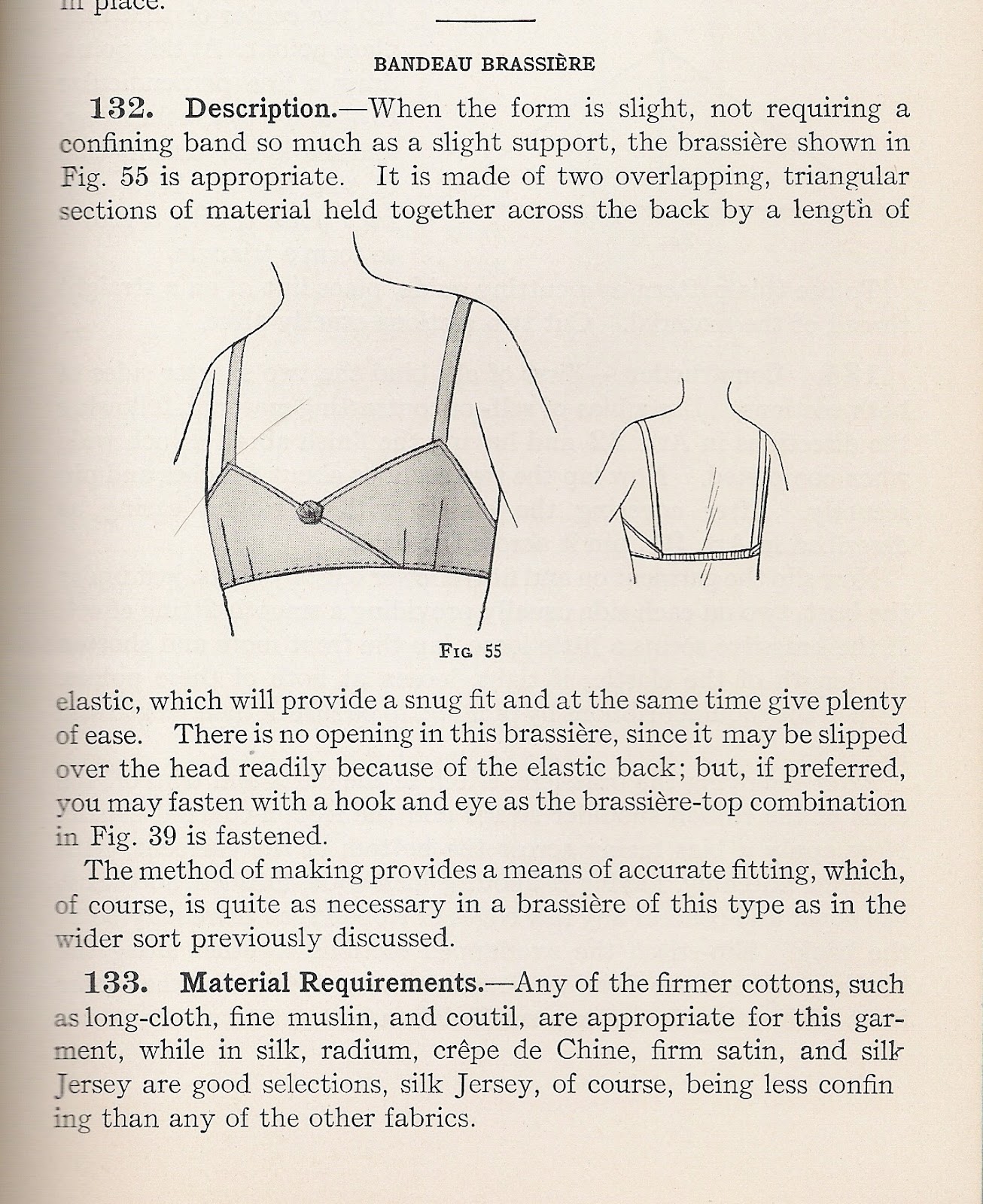
Below are instructions for you to make your own brassiere, somewhat like the one she made and like the one in the early movie from a few posts ago.  These pages are from the Underwear and Lingerie volume of Woman's Institute of Domestic Arts & Sciences series, Part 1, 1925, updated 1930.


If anybody makes one, let me see it!

Maidenform Dec-la-Tay

This Maidenform brassiere features a plunging front and back and nice cup shaping.  The lace is backed by cotton netting and the seams are flat-felled.  The straps are pretty insubstantial silk ribbons and the back is elastic.


 This can be dated to around 1933, as the trademark for Dec la Tay was filed in June and secured in November.


Lookie what I found!  

Article image

Here's an interesting tidbit from the Wikipedia article on Maidenform:  " They named the company Maiden Form, a deliberate contrast with the name of a competitor, "Boyishform Company".[33][52] Maiden Form routed Boyishform by 1924, accenting and lifting rather than flattening the bust. In 1927, William Rosenthal, the president of Maiden Form, filed patents for nursing, full-figured and the first seamed uplift bra.[53]"

Monday, July 23, 2012

Brassieres of the 'Teens

The layers involved in getting dressed in the years from 1910 through 1919 involved the following items (and more):

Chemise


Corset.


This is not my 'teens corset, but you can see it in the picture below.  Just using it for an example.

Below you can see an authentic 'teens corset.  Note that it sits below the bust, making a brassiere necessary.  I did not have a brassiere when I modeled this--but I did not really need one at this time. :)


And, as corsets got lower and lower, a brassiere.  This model has a hook at the bottom with a hole to fasten to one of the studs on the front of the corset to hold it down.  The hook at the bottom was to match a hook on the skirt to keep the skirt in place.


The back of the brassiere had hooks and eyes and elastic, which has been doubled over and sewn together on this one--probably when it lost its stretchiness.


Here you can see the places where bones were inserted to keep everything smooth and the owner made some very nice repairs when the underarms wore out.

This is how the hook attached to the corset stud.


Depending on the time of year and how sheer your slip and dress were, bloomers were also worn.  Here is a beautiful heavy silk satin pair with an elastic waist. When corsets disappeared and girdles appeared, bloomers were worn more often.  I'll show more in a future post.


There's a little extra reinforcement at the knee and look at that beautiful insertion, lace, and little flower.  These are unsold old store stock.

Sunday, July 22, 2012

Medieval Linen Brassieres!

I read in the paper today that there has been a unique discovery of pieces of medieval garments used as wall filler in an old castle in the Tyrol.  Naturally I went online to see if I could find out more about it and find better pictures.  Unfortunately, the archaeologists aren't sharing the pictures--probably so they can write some papers about the garments, but this website gives a really good description and explanation of the finding of the garments.

You can see remnants of needle lace on the edges, and here is a link showing how that needle lace was made.

(I had to go back and repair links and missing pictures for this post in 2021.)

More Early Brassieres

I just ran across this wonderful vintage Pathe film with instructions on how to make a "camisole".  Isn't it cute how the model puts the finished bra on over her camisole?

That got me thinking that I haven't showed the rest of my early brassiere collection.
Here's a pretty homemade one.
It's light yellow silk, but may have been pink at one time.  The filet lace is handmade and cream colored.  The straps are grosgrain ribbon.

Here's the back closing.  The maker added some elastic as she gained a little weight.  That's hook and eye tape.


Check out how the maker folded and stitched the lace to make a tight fit.  She didn't cut the beautiful lace.

Thursday, August 5, 2010

Not So Small

I found another Australian newspaper from 1923 advertising Gossard Longerlyne Brassieres, but there were no pictures. " The ideal brassiere for the not so small figures."  Well, mine IS a size 44.


It looks pretty bad.  I haven't washed it.  Perhaps I should!


Made of heavy peach cotton topped by a doubled cotton lace, and finished with substantial cotton straps, this bra is made for heavier use than the previous ones.  There are triangular inserts of elastic material at the bottom sides.  There is a nice dip in the back, leading me to believe this may be from the 1930's.  It still has the corset hook in the front, however.


Too much glare to read the penciled notation on the folded part.  It read 776, with a line under it, then 175.  That may have been the price.

The H W Gossard Company, of Chicago, IL, was listed in a 1917 trade journal as selling front lacing corsets and brassieres.  This ad is from 1918.
Here is an article about the Ishpeming, Michigan Gossard plant and how it became unionized.  Basically the workers were happy and did not want a union, but the ILGWU didn't like that they were getting more money than union workers and that the company wanted to move more work to Ishpeming because the workers were so much more efficient than union workers, so they sent an agitator there.  The vote went against the union three times.  As soon as they got the union in there, of course it went on strike.  It took a long time to force the company to give them the wages the union thought they should have.  Nobody likes to be forced to do something they don't believe in.  If they had just left them alone the workers would have been happy and so would the company, and things would have progressed normally.  I hate unions.

It seems the Gossard family moved to Colorado and bred livestock with the money from their corset empire.  An interesting history is here.  Go down to the bottom.