Sunday, July 29, 2012

Sil-O-Ette

More of a combination garment than a brassiere, the patent dates this to 1935-1937.  The patent is actually for the way the garment is cut so that it hugs the figure--something new for that time, I guess.

The brassiere is lined in cotton, and the rest of the garment is rayon knit.  The straps are silk ribbon.

It closes on the side with hook and eye tape.


It actually looks very comfy, and quite a change from a corset.


The Sil-O-Ette Intl. Apparel Company is still in existence in Clearwater, FL, although their offerings now are run-of-the-mill fleecewear and t-shirts.

Thursday, July 26, 2012

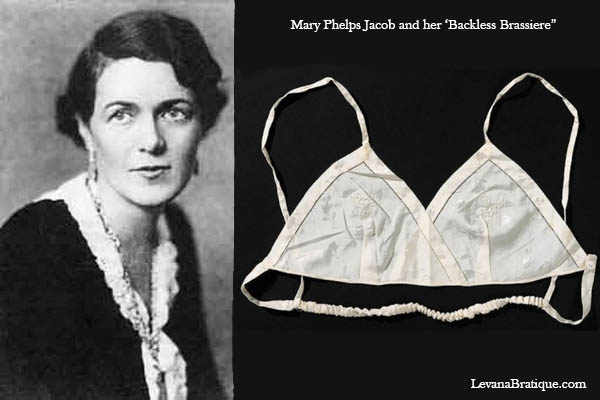
Mary Phelps Jacob, Inventor of the Modern Brassiere


So she is sometimes called.  You can read her story here.  A link to her invention is here.  A Wikipedia article says she was persuaded to sell her fledgling company to Warner Brothers Corset Company by her second husband and join him in debauchery in Europe. (He came to a bad end.)

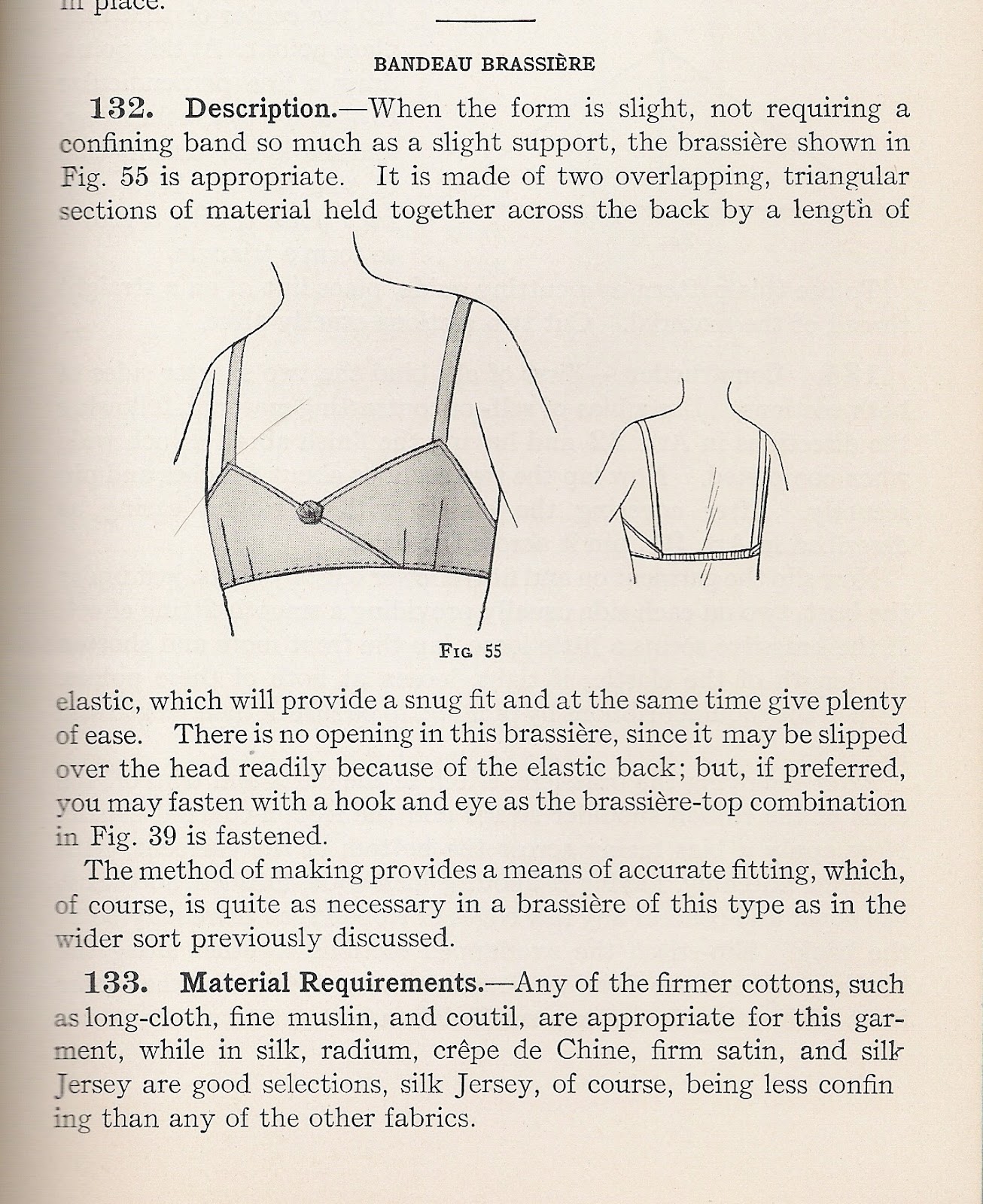
Below are instructions for you to make your own brassiere, somewhat like the one she made and like the one in the early movie from a few posts ago.  These pages are from the Underwear and Lingerie volume of Woman's Institute of Domestic Arts & Sciences series, Part 1, 1925, updated 1930.


If anybody makes one, let me see it!

Maidenform Dec-la-Tay

This Maidenform brassiere features a plunging front and back and nice cup shaping.  The lace is backed by cotton netting and the seams are flat-felled.  The straps are pretty insubstantial silk ribbons and the back is elastic.


 This can be dated to around 1933, as the trademark for Dec la Tay was filed in June and secured in November.


Lookie what I found!  

Article image

Here's an interesting tidbit from the Wikipedia article on Maidenform:  " They named the company Maiden Form, a deliberate contrast with the name of a competitor, "Boyishform Company".[33][52] Maiden Form routed Boyishform by 1924, accenting and lifting rather than flattening the bust. In 1927, William Rosenthal, the president of Maiden Form, filed patents for nursing, full-figured and the first seamed uplift bra.[53]"

Tuesday, July 24, 2012

Marie Tucek and Luman L Chapman, Early Brassiere Innovators

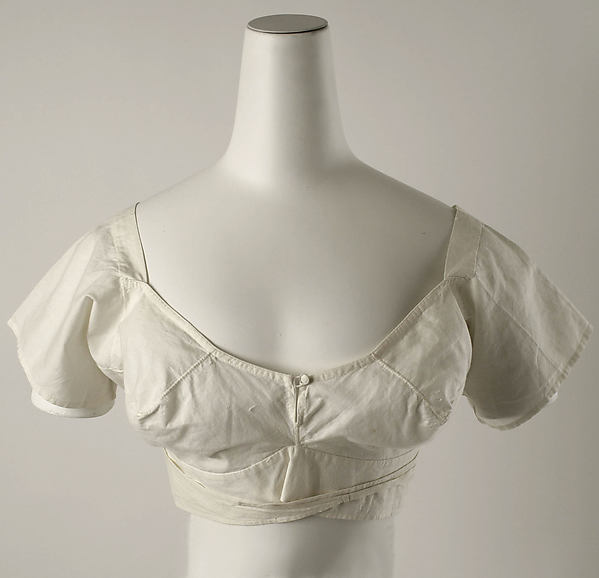
Another early brassiere, this one from 1820, from the collection of the Metropolitan Museum.

Brassiere


MARIE TUCEK

Marie Tucek early saw the need for something to hold up the breasts when the corsets were not supporting them anymore, leading to straps from the shoulders.  Here is her patent.  She explained that this bra was meant to take the place of the corset when wearing empire style dresses.  She also explained that it could be made of sheet metal or cardboard which was covered with silk and bent to the body!


I could not figure out which Marie Tucek she was in New York in 1900, 1910, or 1920.  All the Marys and Maries were either not employed or cigar makers, so evidently, Marie's invention did not prove profitable for her.


LUMAN L CHAPMAN

Luman L Chapman, in 1863, also proposed an alternative to the corset, addressing the need for comfort, avoiding pokey metal springs, and making it easy to put on without help.  This looks pretty comfortable, but the "puffs" are more suited to canteloupes.


I found "Lewman" L Chapman, age 40, born New York, physician, living in Camden, NJ in 1850.  With him are wife Harriett, 27, born Louisiana, daughter Louisa M, age 10, born Mississippi, son Lewman L, age 7, born Missouri, daughter Unis R, age 6, born Pennsylvania, and daughter Harriett, 9 months, born Pennsylvania.

Lewman, or Lowman, as he was called in 1860, must have decided that being a travelling physician was not much fun anymore, and at age 52 was listed as an editor, still in Camden, New Jersey.  Living at home were wife Harriett, daughters Lucy and Harriett, a new son named Vetruvivus, age 6, and David W, nine months.

In an 1867 Philadelphia city directory Luman L Chapman was listed as a corset maker, and also in 1870.

In 1870 Lewman was back to being a physician in Philadelphia, Pennsylvania.  Maybe the Civil War had something to do with that.  At home were Harriet, Lucy, Harriet, Mary, age 12 (where did SHE come from?), and Margaret, age 8, born in Pennsylvania.

I did not find the family in 1880, but burial records indicate that a Luman L Chapman was buried in Mount Morian Cemetery in Philadelphia in 1884.  From 1874 through 1893 there was a Harriett M Chapman in the Philadelphia city directory under corsets.  This may have been Luman's daughter.  She is listed again in 1908, but with no occupation.

HARRIET M CHAPMAN

Harriet M Chapman had her own patented corset in 1875.  This is probably what she was making for all of those years.  It's got an inner, adjustable belt for "corpulent persons".


Monday, July 23, 2012

Brassieres of the 'Teens

The layers involved in getting dressed in the years from 1910 through 1919 involved the following items (and more):

Chemise


Corset.


This is not my 'teens corset, but you can see it in the picture below.  Just using it for an example.

Below you can see an authentic 'teens corset.  Note that it sits below the bust, making a brassiere necessary.  I did not have a brassiere when I modeled this--but I did not really need one at this time. :)


And, as corsets got lower and lower, a brassiere.  This model has a hook at the bottom with a hole to fasten to one of the studs on the front of the corset to hold it down.  The hook at the bottom was to match a hook on the skirt to keep the skirt in place.


The back of the brassiere had hooks and eyes and elastic, which has been doubled over and sewn together on this one--probably when it lost its stretchiness.


Here you can see the places where bones were inserted to keep everything smooth and the owner made some very nice repairs when the underarms wore out.

This is how the hook attached to the corset stud.


Depending on the time of year and how sheer your slip and dress were, bloomers were also worn.  Here is a beautiful heavy silk satin pair with an elastic waist. When corsets disappeared and girdles appeared, bloomers were worn more often.  I'll show more in a future post.


There's a little extra reinforcement at the knee and look at that beautiful insertion, lace, and little flower.  These are unsold old store stock.

Sunday, July 22, 2012

Medieval Linen Brassieres!

I read in the paper today that there has been a unique discovery of pieces of medieval garments used as wall filler in an old castle in the Tyrol.  Naturally I went online to see if I could find out more about it and find better pictures.  Unfortunately, the archaeologists aren't sharing the pictures--probably so they can write some papers about the garments, but this website gives a really good description and explanation of the finding of the garments.

You can see remnants of needle lace on the edges, and here is a link showing how that needle lace was made.

(I had to go back and repair links and missing pictures for this post in 2021.)

More Early Brassieres

I just ran across this wonderful vintage Pathe film with instructions on how to make a "camisole".  Isn't it cute how the model puts the finished bra on over her camisole?

That got me thinking that I haven't showed the rest of my early brassiere collection.
Here's a pretty homemade one.
It's light yellow silk, but may have been pink at one time.  The filet lace is handmade and cream colored.  The straps are grosgrain ribbon.

Here's the back closing.  The maker added some elastic as she gained a little weight.  That's hook and eye tape.


Check out how the maker folded and stitched the lace to make a tight fit.  She didn't cut the beautiful lace.